
OUR VALUE CHAIN
Our value chain illustrates how value is created across each stage of our operations, from sourcing and manufacturing to distribution and end-of-life.
Upstream
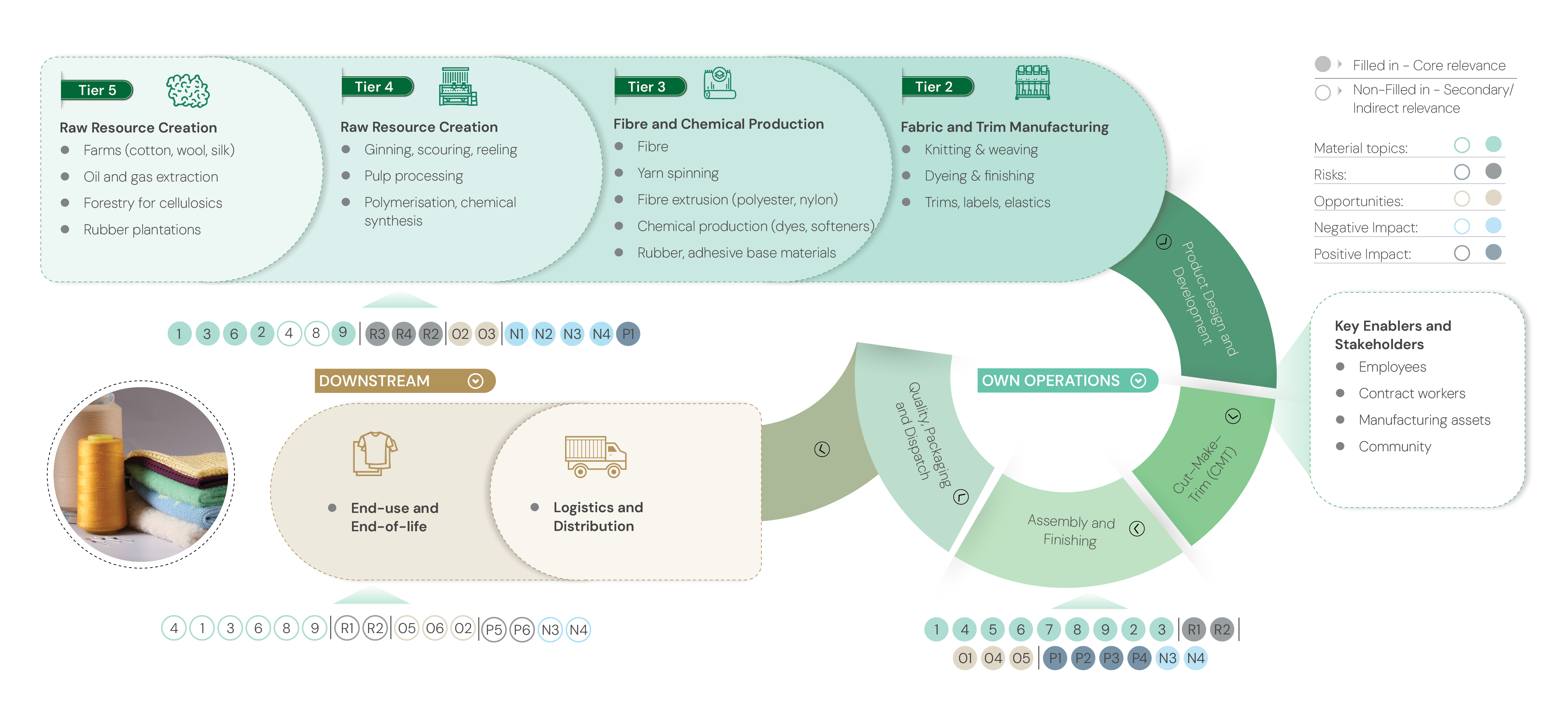
Material Topics, Risks, Opportunities and Impacts Mapped Across the Value Chain
Material Topic | Upstream | Own Operations | Downstream | Key GRI Standards |
|---|---|---|---|---|
1Climate & Energy | Fibre & fabric emissions | Energy use, renewables | Freight emissions | GRI 302, GRI 305 |
2Water & Effluents | Dyeing & finishing | Process water, ZLD | Indirect impact | GRI 303 |
3Chemicals & Materials | Hazardous inputs | Chemical handling | Product safety | GRI 301, GRI 306 |
4Waste & Circularity | Fabric waste | Cutting waste | End of life textiles | GRI 301, GRI 306 |
5Occupational Health & Safety | Limited | Core exposure | Limited | GRI 403 |
6Labour & Human Rights | Forced / child labour risk | Wages, wellbeing | Extended supply chain | GRI 402, 404, 408, 409 |
7Diversity, Equity & Inclusion | — | Workforce and leadership | — | GRI 405 |
8Economic Performance | Input cost volatility | Value creation | Customer value | GRI 201 |
9Ethics & Compliance | Supplier conduct | Business ethics | Brand trust | GRI 205 |
Opportunities
- O1Energy and emissions efficiency across operations and the value chain
- O2Adoption of sustainable and circular materials
- O3Advancement of low-impact processing and chemical innovation
- O4Strengthening product innovation and design capabilities
- O5Enhancing supply chain transparency and preferred partner positioning
- O6Strengthening stakeholder trust and long-term relationships
Positive Impacts
- P1Material and process innovation
- P2Energy & water efficiency
- P3Worker wellbeing
- P4Skills & employment
- P5Circularity initiatives
- P6Customer sustainability support
Risks
- R1Climate-related disruption
- R2Regulatory non-compliance
- R3Resource scarcity
- R4Labour rights violations
- R5Reputational risk
Negative Impacts
- N1Environmental footprint
- N2Social and labour risks
- N3Waste generation
- N4Compliance risks