
Impact Review · Products

ProductsChanged for Good
We are redesigning how apparel products are created by scaling circular materials, advancing responsible sourcing systems, and embedding innovation across our design-to-delivery model, helping our brand partners transition toward next-generation product ecosystems.



Circular and next-generation material partners onboarded and materials validated across portfolios
Our Approach
Our sustainable product strategy reflects a structured shift in how we design, develop, and deliver products by embedding sustainability at the heart of product creation, while responding to evolving industry expectations and advancing positive impact across the apparel sector.
We are guided by a clear definition of sustainable products — those that are good for the wearer, good for the planet, and good for business. We have embedded this into how we grow, by linking progress in sustainable products directly to business performance.
Building on this foundation, we are advancing the integration of next-generation circular materials and product platforms across our portfolio toward 2030.
- 1
- 2
- 5
- 8
- 9
Sustainability is brought to life through the products we create
Bringing together materials, processes, and performance to create tangible outcomes.
Products at the Core
At MAS, sustainability is ultimately realised through the products we create. While environmental and social initiatives continue to evolve across the business, it is through product design, material selection, and manufacturing processes that these efforts are translated into tangible outcomes.
A Collaborative Effort
This perspective shapes how product sustainability is approached — bringing together considerations such as material impact, resource efficiency, and compliance into the way products are developed and delivered. In this sense, product sustainability is not a standalone initiative, but the convergence of multiple efforts across the value chain, including global brands, material innovators, and responsible producers.
Putting Commitment into Practice
Product sustainability is therefore closely linked to how materials are selected, how products are made, and how they perform over time — reducing environmental impact through improved material choices, lowering water and carbon intensity in production, and strengthening product safety and compliance with global standards.

Our Role in Enabling Change
As a manufacturer, MAS operates at the intersection of brands and supply chains. This position enables the business to translate emerging technologies and material innovations into scalable product solutions.
By working closely with partners across the value chain, MAS supports the adoption of sustainable materials and circular approaches — bridging the gap between innovation and commercial application. This role is particularly important in areas such as circularity, where alignment between multiple stakeholders is required to move from concept to scale.
Moving Forward
Looking ahead, MAS will continue to focus on strengthening sustainable material pathways, advancing circularity, and aligning product development with evolving regulatory and stakeholder expectations.
These efforts provide the foundation for the next phase of progress — where sustainability is increasingly embedded into every product, and scaled across the portfolio.
- Evolving global regulations
- Changing industry standards
- Increasing brand expectations
- Constraints in recycled material supply
- Lower material impact
- Reduced resource intensity
- Compliance with global standards
- Improved product performance
- Designed for recyclability and circularity
- Extended product lifetime through durability
Upholding Our Commitment to Sustainable Products
Our approach to sustainable products is guided by a clear and structured framework. The Sustainable Product Criteria embeds sustainability into how products are designed, sourced, and manufactured — defining and assessing products across raw materials, design and merchandising, manufacturing processes, circularity, and social impact.
Applied across product teams and monitored centrally, it ensures sustainability is considered consistently throughout the product lifecycle, while continuing to evolve alongside new technologies and industry practices.
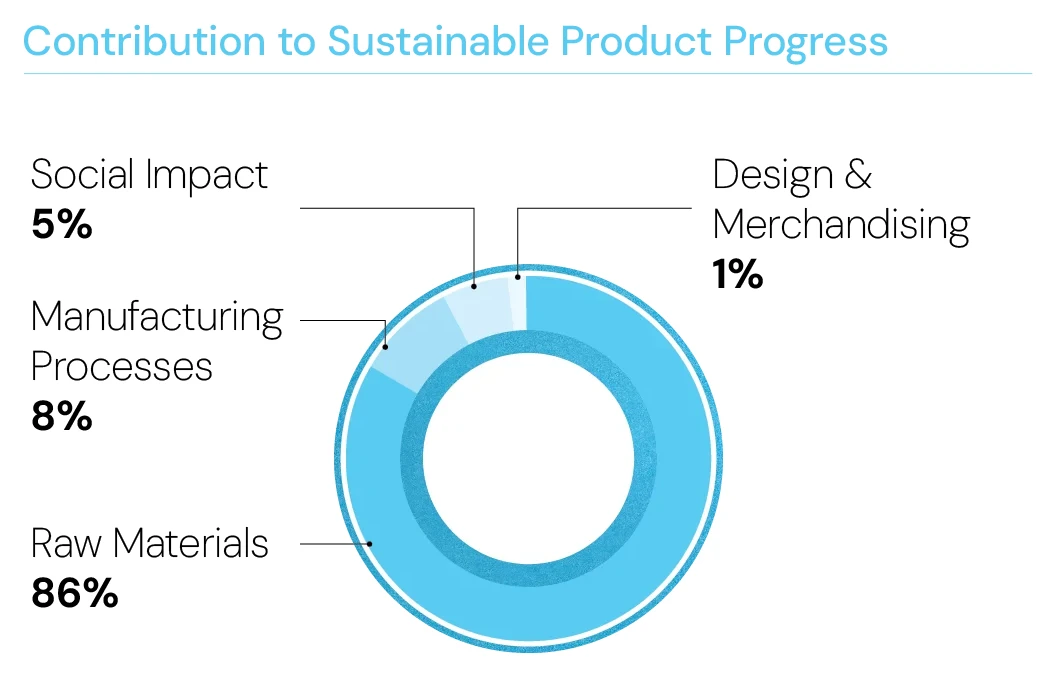
In 2025, our commitment continued to translate into steady progress across the portfolio. Progress was predominantly driven by raw materials, reflecting the continued shift toward more sustainable and next-generation inputs.
Manufacturing improvements and products with positive social outcomes also contributed, while design and merchandising remain an area where deeper integration will be important going forward.
Raw Materials
Revenue generated through products made using sustainable and next-generation materials.
Design & Merchandising
Revenue generated through improvements in design and merchandising processes.
Manufacturing Processes
Revenue generated through improvements to manufacturing efficiency and impact.
Social Impact
Revenue generated through products delivering positive social outcomes.
- Raw Materials
- Design & Merchandising
- Manufacturing Processes
- Circularity
- Social Impact
Material choices remain central to this transition. Recycled inputs accounted for 15% of primary product materials during the year, while renewable materials represented 34% of the overall input profile.
Cotton, polyester and nylon continue to make up the majority of the portfolio, reinforcing the importance of strengthening sustainable pathways across both natural and synthetic fibre categories.
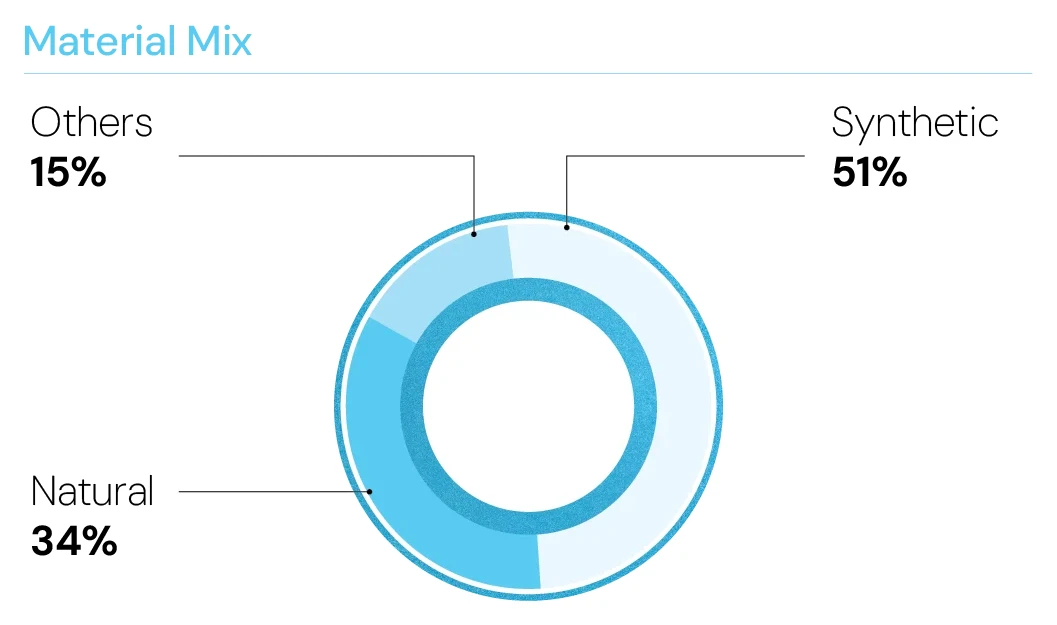
Naturals: includes Cotton and Modal
Synthetics: includes Nylon, Polyester, Spandex
34%
Renewable
51%
Non-renewable
15%
Recycled
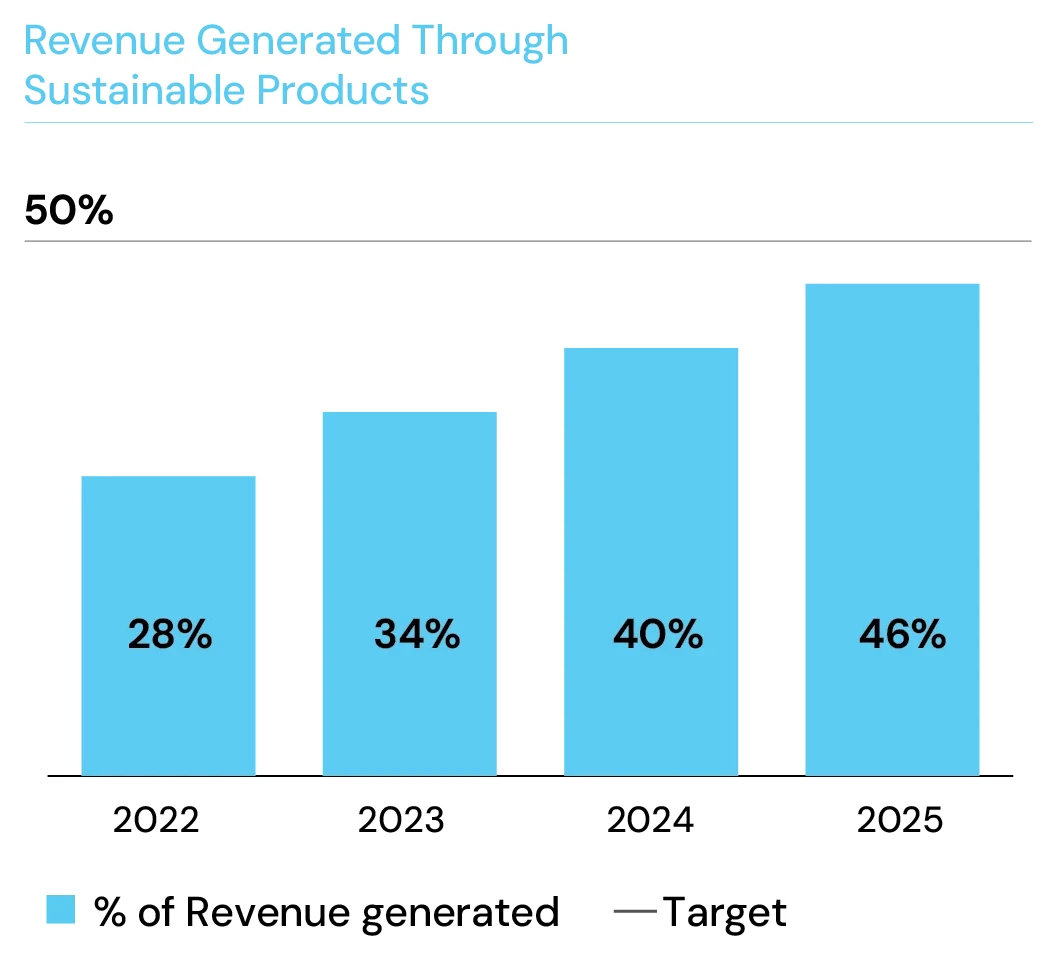
Revenue from sustainable products
Climbing from 28% to 46% in four years
Sustainable products contributed 46% of revenue in 2025, continuing a steady increase from 28% in 2022. While this reflects strong progress, it remains slightly below the 50% target, highlighting the continued effort required to scale adoption across product lines.
Translating criteria into practice

Material Adoption
Continued use of recycled inputs alongside a growing shift toward alternative and next-generation material pathways, supported by expanded access to sustainable yarns.

Circularity
Progress in textile-to-textile pathways, including developments in polyester and early-stage work in nylon.

Manufacturing
Further alignment with bluesign® standards in dyeing and finishing, including onboarding of Noyon Lanka as a certified partner.

Innovation Integration
Material validation and product trials supported application of next-generation materials, including HeiQ AeoniQ™.
“Sustainable products contributed 46% of revenue in 2025, continuing a steady increase from 28% in 2022.”
An Evolving Landscape
Evolving regulatory expectations are increasingly shaping how products are designed, validated, and brought to market. MAS continues to align its product innovation and material strategies with these developments to ensure compliance, credibility, and long-term market relevance.
| Regulatory development | What it means for MAS | Our response |
|---|---|---|
| Established regulations | ||
| Product Environmental Footprint (PEF) | Greater emphasis on measurable environmental performance and comparable product-level data. | Strengthening LCA-based validation, benchmarking next-generation materials against conventional baselines, and expanding lifecycle data readiness to align with EU PEF Category Rules for apparel. |
| Ecodesign for Sustainable Products Regulation (ESPR) | Increased focus on circularity, durability, and resource efficiency in product design. | Advancing circular material pathways and embedding durability and efficiency into product development. |
| Digital Product Passports (DPP) | Increased need for traceability and structured product-level data. | Enhancing data systems and preparing for product-level disclosure requirements. |
| EU Textile Strategy & Waste Regulations | Acceleration of circular material adoption and waste reduction. | Expanding textile-to-textile recycling and scaling the use of recycled materials, while strengthening product design for recyclability and advancing lifecycle responsibility across products. |
| REACH & Chemical Regulations (EU) | Stricter requirements on chemical use and material safety. | Strengthening material selection processes and aligning with global standards for safer inputs. |
| Emerging regulations & policy direction | ||
| Green Claims Directive (EU) | Stronger expectations for substantiated and verifiable sustainability claims, with increased scrutiny on product-level disclosures. | Strengthening internal validation frameworks, enhancing traceability of product claims, and aligning disclosures with LCA-backed evidence. |
Our product strategy
Three reinforcing focus areas
Operating at the intersection of brands and supply chains, our sustainable product strategy rests on three commitments — each explored in depth on its own page.