
Practicing responsible chemical management in the apparel industry gives us the means to minimise harm and maximise positive impact to achieve far-reaching benefits for employees, consumers, and the environment.
Our goal, to be zero toxic in products and processes, involves a commitment to green chemistry practices and a continuous journey to study chemical impacts, incorporate regulatory requirements, uphold industry best practices, and meet consumer expectations.
To this end, we are actively streamlining chemical management within our facilities, implementing robust procurement controls, forging collaborative partnerships with chemical suppliers, and upholding transparency through rigorous verification and certification.
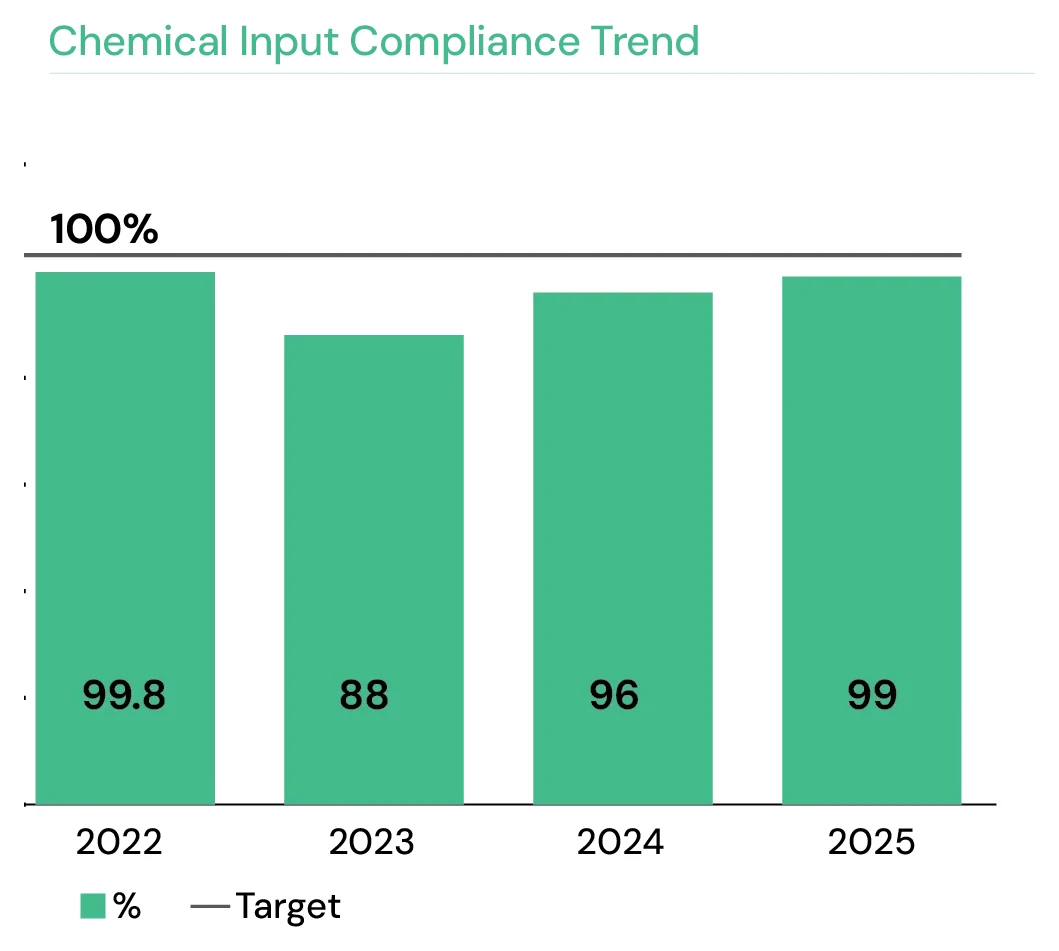
In 2025, these efforts delivered strong performance, with overall compliance reaching 99% according to ZDHC performance InCheck criteria, supported by improvements across facilities and the value chain.
0%
ZDHC MRSL v3.1 Level 1 compliance or above
0%
overall chemical input compliance in 2025 (↑ from 96% in 2024)
0%
compliance in dye facilities (↑ from 99% in 2024)
0%
compliance in embellishment facilities (↑ from 88% in 2024)
0%
compliance with ZDHC wastewater discharge limits
Key Priorities Shaping Responsible Chemical Use
Chemical risks are managed within the operational boundary, from input selection and procurement to process control, wastewater treatment and supplier engagement, supporting consistent compliance and minimising environmental impact.
Driving safer inputs and improving visibility across operations
Enhancing controls over chemical selection and procurement, while increasing the use of approved and lower-risk alternatives to ensure consistent compliance across facilities and the supply chain, aligned with internal standards and internationally recognised practices and frameworks.
Managing use, discharge, and downstream impacts
Strengthening process controls, wastewater treatment, and monitoring systems to minimise environmental impact and prevent leakage across operations and the supply chain, in line with regulatory requirements and internationally recognised wastewater guidelines and standards.
Strengthening Input Compliance
Driving Safer Inputs and Improving Visibility Across Operations
MAS continued to strengthen input chemical management through enhanced procurement controls, improved transparency, and alignment with ZDHC MRSL requirements. By controlling chemical inputs at source, the Group minimises the risk of hazardous substances entering processes and subsequently impacting products, employees, and the environment.
These efforts enabled overall compliance to reach 99% in 2025, with 100% compliance achieved in dye facilities and significant improvement in embellishment facilities to 97.2% (2024: 88%), reflecting a 9% increase in performance.
The transition towards safer alternatives continued to grow, with 97.2% of chemicals used in dye facilities being bluesign®-approved (2024: 95.4%), supported by procurement Standard Operating Procedures (SOPs) mandating the use of approved dyes and auxiliaries. Alignment with the ZDHC Commodity Chemical Guide was also implemented across operations, strengthening consistency in chemical selection and reducing reliance on higher-risk inputs.
Reinforced by system maturity and certification progress:
- 16 OEKO-TEX Standard 100 certifications covering 24 facilities
- 22 facilities completed ZDHC Supplier to Zero Level 1 Self Assessment, with 2 facilities achieving Level 2
- 1 facility achieved ZDHC Verified InCheck Level certification
Served as a key enabler of compliance:
- 43 RSL tests were conducted to meet customer-specific requirements
- Approx. 100 additional tests covering bisphenol, formaldehyde, and AFIRM RSL
- Training delivered across all levels, including executive sessions on ZDHC MRSL, bluesign®, and internal policies, while selected staff participated in RSL trainings conducted by Nike, GAP, Skims, and HBI
- ZDHC CMS TIG certification expanded to 47 trained staff
Supported reduced chemical intensity and improved efficiency:
- Dye substitution and recipe standardisation reduced process time from 3 hours to 2 hours conducted in Noyon Lanka (Pvt) Ltd.
- Introduction of a grey dye process at Texo (Pvt) Ltd reduced batch run time by 2.15 hours, delivering: – 0.55 kWh/kg energy savings | 18.9 L/kg water reduction – Elimination of 5 chemicals
- Reuse of dye machine cooling water with a capacity of approx. 50 m³/day and adoption of the VECO dye method further reduced chemical usage at Texo (Pvt) Ltd.
- In 2025, we continued the initiatives introduced in 2024, including chemical replacements, MLR improvements, and process optimisations, maintaining a focus on reducing water, energy, and chemical use while improving overall efficiency.
Implementation of Commodity Chemical Guidelines and Benchmarking of Facilities
In 2025, we implemented the ZDHC Commodity Chemical Guide, ensuring alignment of all commodity chemicals with its requirements. To support consistent implementation and performance benchmarking, we continued to assess our facilities through the Higg Facility Environment Module (FEM) and the internal MAS SCAlE (Sustainability Calibration for Environment) tool. Extending this approach across the value chain, a forum was held on 5th February 2026 with sub-contractors to review 2025 performance and align on 2026 expectations relating to input compliance, process controls, and output compliance.
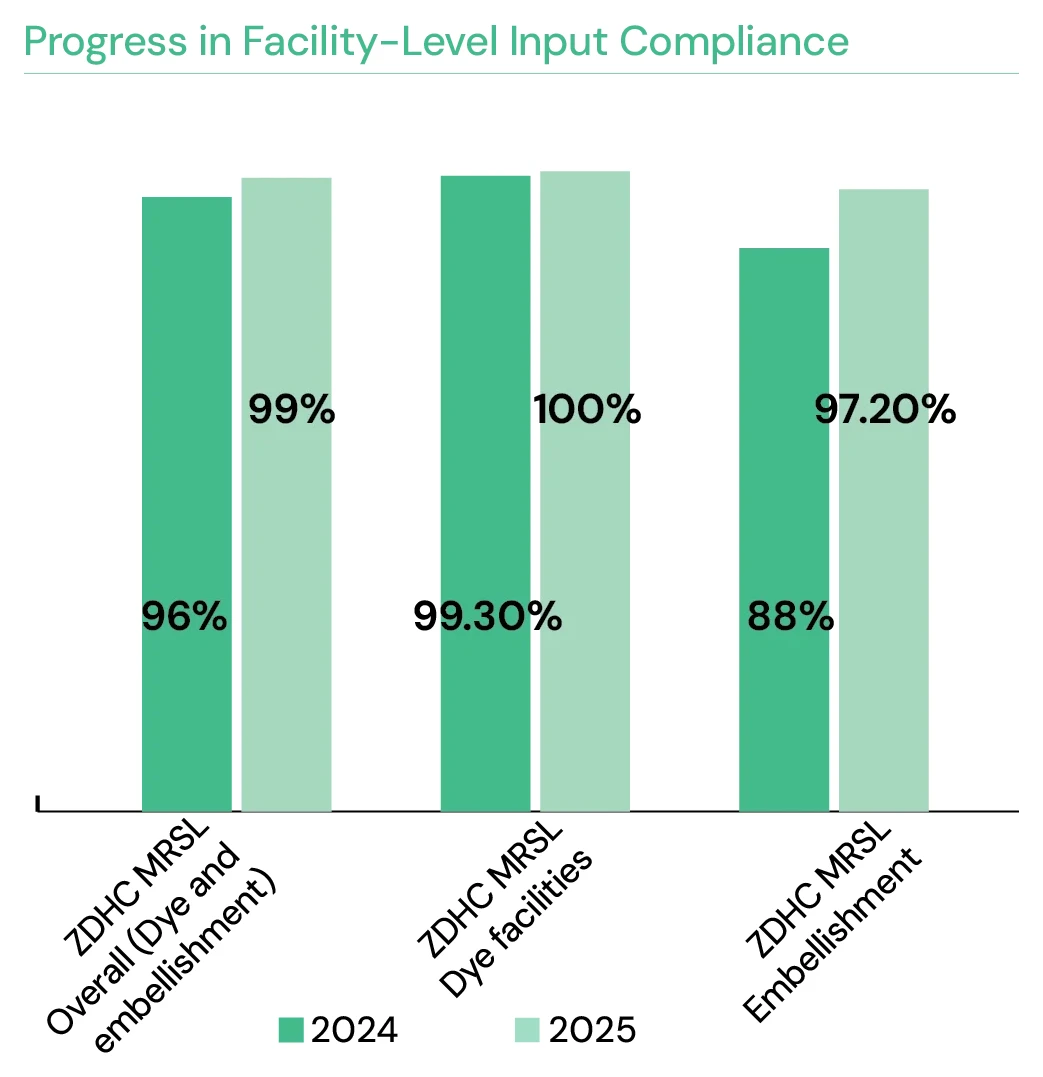
99%
overall input compliance (↑ 3 pp)
100%
dye facilities (↑ 0.7 pp)
97.2%
embellishment (↑ 9 pp)
97.2%
bluesign® approved chemicals used in dye facilities (↑ 1.8 pp)
Advancing the bluesign® Commitment Across our Operations
In 2022, we began alignment of our chemical management with bluesign® – one of the most stringent global sustainable chemical certifications. As of 2025, MAS Fabrics Private Limited – Intimo Division remains a bluesign® System Partner delivering bluesign® certified articles, while Noyon Lanka (Pvt) Ltd and Texo (Pvt) Ltd have obtained bluesign® system partnership during the year. The process of obtaining bluesign® system partnership for apparel facilities was also initiated in 2025.
Dye Facility SOPs for chemical procurement aligned with the MAS Chemical Management Manual, mandates the use of bluesign® dyes and auxiliaries for dyeing operations. Success in this regard saw our Dye Facilities enhance compliance in 2025, achieving 97.2% bluesign®-approved chemicals. To support the mainstreaming of this commitment, we conducted staff training programmes that included awareness on bluesign® standards, and assessed the latest updated version of bluesign® Black Limits for threshold limits, standards, and guidance to inform our processes. We prioritised sourcing of low-risk bluesign®-approved chemicals and continued to encourage the use of bluesign®-approved chemicals across all inputs and in-house chemical use.
Reducing Chemical Risk and Environmental Impact
Managing Use, Discharge, and Downstream Impacts
We maintained robust controls to manage the environmental impacts of chemical use, particularly in relation to wastewater discharge and the potential contamination of water bodies. Industrial wastewater from all relevant facilities was monitored against- ZDHC Wastewater Guideline, as well as local regulatory requirements including Central Environmental Authority (CEA) and Board of Investment (BOI) standards. Together, these measures ensure that chemical use does not result in adverse discharge impacts, while safeguarding surrounding ecosystems and communities.
Monitoring wastewater includes:
- Quarterly compliance reporting to local regulators
- Biannual testing of wet processing facilities in line with the ZDHC requirements
- Disclosure of performance through the ZDHC Gateway
In 2025, no instances of non-compliance with ZDHC wastewater discharge limits were recorded, reflecting strong operational control and consistent adherence to global standards.
Refer Awards and Recognition for more details on our achievements during the year.
Supply Chain
Supply chain engagement continued to expand, strengthening the management of chemical-related impacts beyond direct operations, with a focus on Tier 1 suppliers engaged in wet processing and chemical-intensive operations.
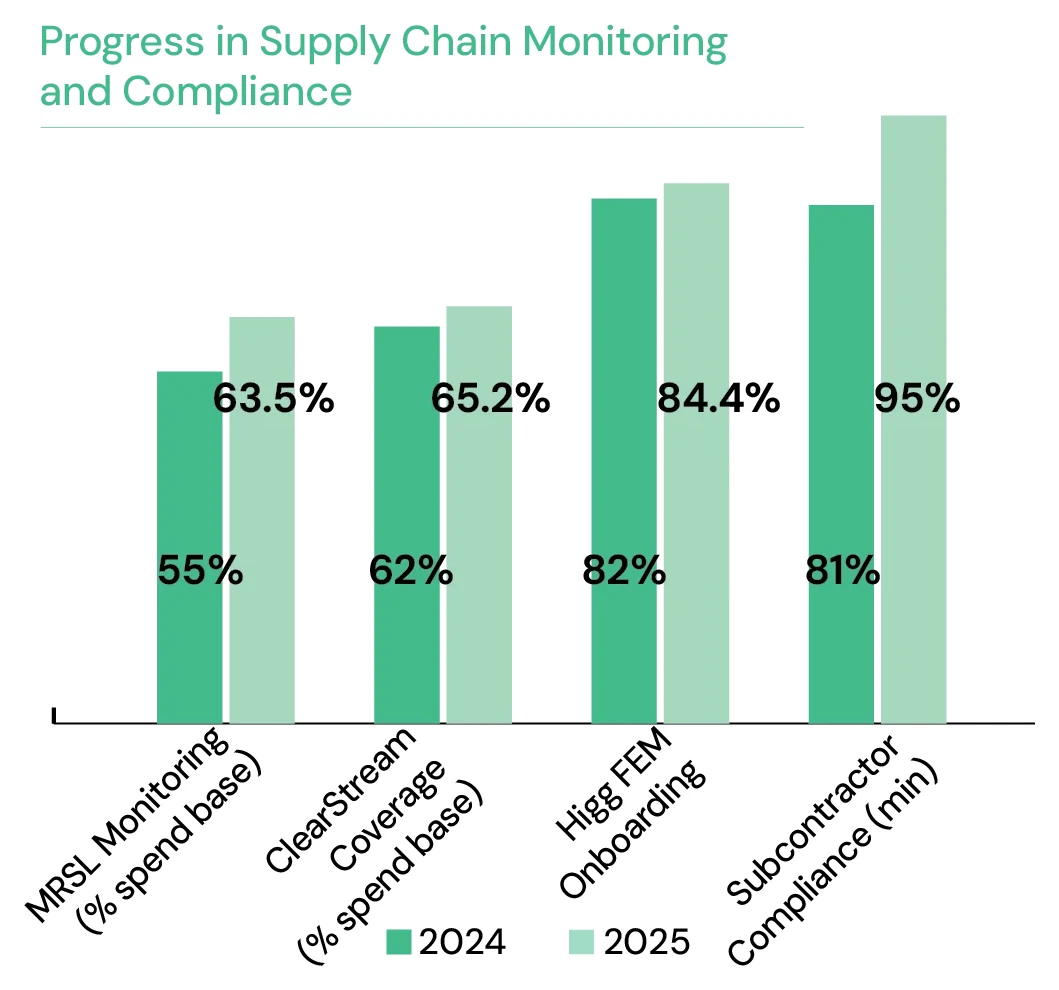
Monitoring focused on suppliers representing the top 90% of the spend base, with progressive coverage achieved through ZDHC tools. This included input chemical compliance through InCheck reporting and wet processing discharge monitoring through ClearStream reporting via the ZDHC Gateway.
- 63.5% of spend base monitored against ZDHC MRSL (2024: 55%)
- 65.2% of spend base generated ClearStream reports (2024: 62%)
- 83.6% of suppliers onboarded to Higg FEM (2024: 82%)
Zero incidents of non-compliance was maintained against ZDHC wastewater discharge limits through continuous monitoring, periodic testing, and proactive supplier engagement.
Subcontractors
Subcontractor performance improved significantly across key chemical management areas:
- Minimum 95% compliance achieved across all subcontractors (2024: 81%), with three facilities achieving 100% compliance against ZDHC MRSL Version 3.1
- 90% of subcontractor facilities aligned with ZDHC Wastewater Guidelines through wastewater testing
- 100% of subcontractor facilities monitored for completion of verified Higg FEM assessments, with 90% achieving ≥80% scores
Structured engagement mechanisms supported this progress:
- Annual subcontractor forums to communicate expectations and performance
- Interim monitoring reviews to track compliance and address gaps
- Collaborative identification and substitution of chemicals of concern
63.5%
MRSL monitoring (↑ 8.5 pp)
65.2%
ClearStream Report Generation (↑ 3.2 pp)
83.6%
onboarded to Higg FEM (↑ 2.4 pp)